
Wiring Systems Designed for Modern Power Demands
New construction electrical in Spearfish for residential and light commercial builds where framing and rough-in sequencing affect every trade that follows
Framing crews set the pace, but electrical rough-in determines whether drywall, HVAC, and finish trades can proceed on schedule or sit idle waiting for conduit and wiring to clear inspections. Canyon Electric handles rough-in and final electrical installations for new residential and light commercial construction across the Black Hills, coordinating directly with builders and other trades to keep sequencing tight. A delay in rough-in that pushes an inspection by even a few days can cascade across every trade scheduled behind it.
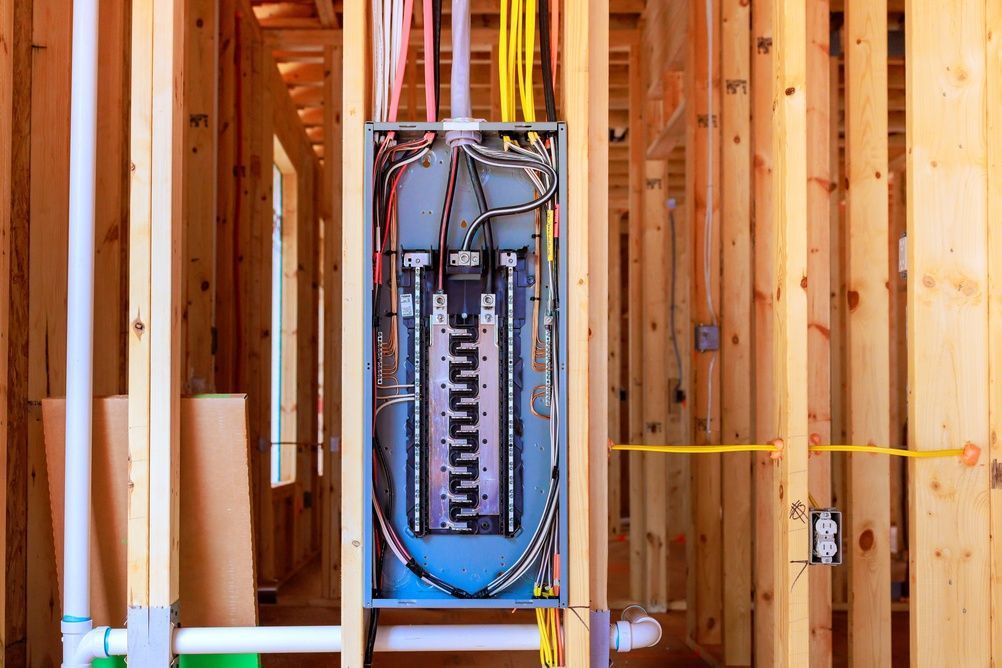
Rough-in work involves routing conduit and wiring through framing according to the electrical plan, with circuit layout and panel size established through load calculations that account for the building's total demand. The panel sizing decision at this stage—whether a 150-amp or 200-amp service fits the build—affects everything from the main breaker specification to the number of branch circuits available for kitchens, HVAC equipment, and future additions. Industry-standard routing practices and quality materials at this phase prevent the rework that drives cost overruns and inspection failures on final connections.
Discuss your construction schedule with Canyon Electric early to coordinate rough-in timing with your framing and inspection milestones.
What the Rough-In and Final Stages Actually Involve
Rough-in is not simply pulling wire through holes in studs. It requires planning circuit groupings so related loads share appropriately sized branch circuits, positioning outlet and switch boxes at the correct height and spacing for code compliance, and leaving service loops of adequate length at each device location so finish electricians can make clean, secure final connections. Canyon Electric performs these steps in coordination with the construction timeline so rough-in inspections can be scheduled without holding up drywall.
At final connections, once walls are closed and the build has advanced far enough, all circuit wiring is terminated at the panel, outlets, switches, and fixtures are installed and tested, and the system is verified before the certificate of occupancy inspection. The result is a panel with clearly identified circuits, devices that operate without loose connections, and wiring routed in a way that future service calls can be diagnosed efficiently rather than traced through unmarked runs.
Light commercial builds in the Black Hills introduce additional considerations around dedicated circuits for commercial kitchen equipment, data and communications infrastructure, and exterior lighting that residential construction does not typically require. These are scoped during the load calculation phase so the panel and service entrance are sized correctly from the start rather than retrofitted after occupancy.
Questions Before Starting Your Construction Project
Builders and property owners working on new construction in Spearfish and across the Black Hills commonly ask about sequencing, panel sizing, and how electrical work fits into the broader construction timeline.
What determines the panel size for a new construction build?
Load calculations account for square footage, HVAC equipment, kitchen appliances, EV charger provisions, and any other continuous or high-demand circuits—most modern single-family homes in this region are designed for 200-amp service to accommodate current appliance loads and future additions.
How does electrical rough-in coordinate with framing and other trades?
Rough-in begins after framing is complete and before insulation or drywall is installed, and Canyon Electric works directly with your general contractor to schedule around inspection windows so downstream trades are not delayed.
Why does outlet and switch box placement during rough-in matter for the finish stage?
Boxes positioned incorrectly relative to finished floor height or wall finish thickness require relocation that damages drywall and adds labor cost—precise placement during rough-in prevents that entirely.
When should a new construction build in Spearfish include provisions for an EV charger even if one is not being installed immediately?
Running a conduit stub and pulling a circuit to the garage during rough-in costs significantly less than cutting through finished walls and ceilings to add that circuit after occupancy.
What should a builder look for when selecting an electrician for new construction?
Familiarity with reading electrical plans, experience with load calculations for panel sizing, and a clear process for coordinating inspection scheduling with the overall project timeline are practical indicators of a contractor who will keep the build on track.
Canyon Electric offers free estimates for new construction projects and works with builders across the Black Hills to fit electrical scope into project timelines from the start. Call (605) 639-0505 to discuss your build schedule and electrical requirements before framing begins.