
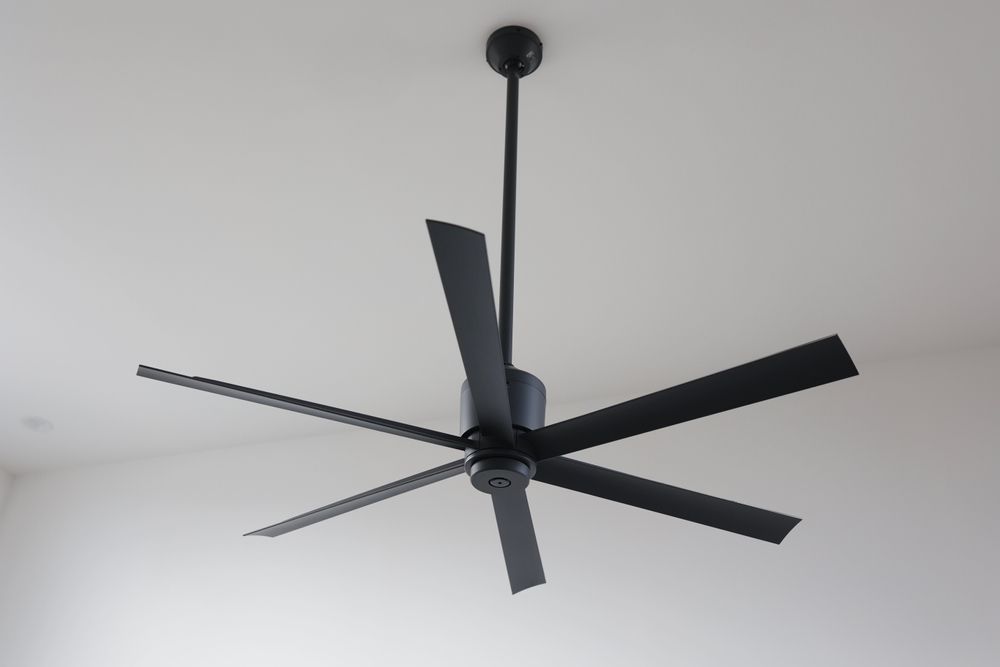
Fans Mounted Safely and Balanced on the First Visit
Ceiling fan installation in Spearfish for homes needing secure electrical mounting and proper circuit connection in rooms with or without existing fixtures
Standard outlet boxes installed for light fixtures aren't rated to hold a ceiling fan's dynamic weight load—a fan spinning at full speed exerts lateral and downward forces that a fixture box can't safely anchor. Canyon Electric installs ceiling fans in homes and light commercial spaces in Spearfish and the Black Hills area, starting with a check of the mounting box before anything else gets assembled. Skipping that step is the most common reason fans wobble, loosen over time, or fail at the ceiling mount entirely.
The installation sequence runs from power off at the breaker, through box inspection and upgrade if needed, then wiring the fan's supply to the appropriate switch or control location, mounting the motor assembly to the rated box, attaching blades, and completing a rotation and balance test before the job is done. Spearfish homes benefit from ceiling fans in both directions—counterclockwise in summer moves air across occupied spaces for cooling effect, and clockwise at low speed in winter pushes warm air that pools at the ceiling back down to living areas. Most installations are completed in one to two hours.
Request a free estimate to confirm the scope of your fan installation, including whether an existing mounting location needs a box upgrade or new wiring.
What Ceiling Fan Installation Actually Accomplishes
The mechanical part of fan installation is straightforward when the electrical side is already in place—the complexity increases when the installation is in a room without an existing ceiling fixture. In those cases, a new circuit run from the switch location to the ceiling, through whatever framing path is accessible, is part of the scope. Canyon Electric handles both scenarios: straightforward replacements of existing fixtures and new installations in rooms that currently have no overhead electrical connection.
After installation is complete, the fan runs at all speeds without wobble or noise from a loose mount, the light kit operates on the correct switch leg or remote channel, and the blades track level without the visible dip that signals an unbalanced assembly. Those are the observable markers of a correctly installed fan—any wobble or rhythmic noise after installation points to a mounting or balance issue that wasn't resolved at the time of the job.
Fans with remote controls or integrated smart-home receivers require wiring that accounts for the additional control leads in the canopy—not all ceiling boxes have adequate depth for those components, which is another reason box condition is evaluated before the fan assembly goes up. Free estimates are included, covering both labor and any box upgrade that the mounting location requires.
Questions Before Starting Your Fan Installation
Ceiling fan installations raise practical questions about compatibility, wiring requirements, and what the job actually covers. These answers address what property owners in Spearfish typically want to know in advance.
What happens if my ceiling box isn't rated for a ceiling fan?
A standard fixture box will be replaced with a fan-rated brace box or a retrofit brace that anchors directly to the ceiling joists—that upgrade is assessed and handled as part of the installation rather than flagged after the fan is already unboxed.
How does an electrician install a ceiling fan in a room without a light fixture already?
New wiring is routed from the intended switch location to the ceiling position through available framing pathways; the scope of that work depends on the room layout and wall construction, which is why an on-site estimate is more accurate than a flat rate.
Why does ceiling fan direction matter seasonally in South Dakota?
Counterclockwise rotation in summer creates a downdraft that produces a cooling effect in occupied rooms; clockwise rotation at low speed in winter moves accumulated warm air from ceiling level back into the living space, which reduces heating load.
Can an electrician install a fan with a remote control or smart home integration?
Yes—Canyon Electric handles fans with remote receivers and integrated smart-home controls, which require careful wire routing inside the canopy and confirmation that the ceiling box has adequate clearance for the additional components.
How long does ceiling fan installation typically take?
Most single-fan installations in rooms with existing ceiling fixtures are completed in one to two hours; rooms requiring new wiring from scratch take longer depending on routing complexity, which the estimate will specify.
Canyon Electric covers free estimates on all ceiling fan installations, including box inspections and any wiring that the location requires. Call (605) 639-0505 to schedule your installation or get a firm scope before purchasing your fan.