
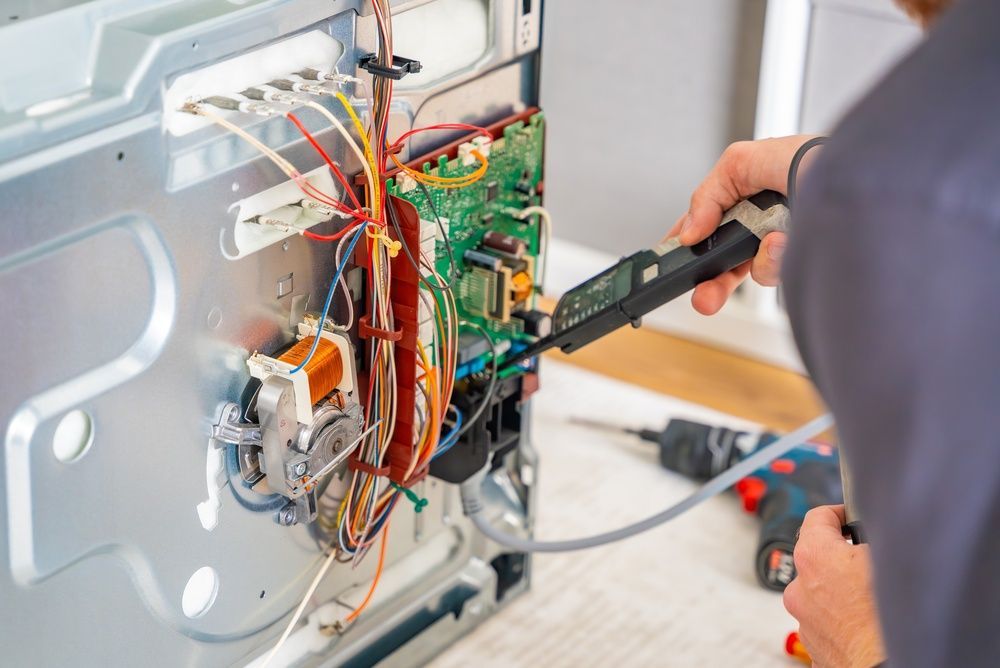
Dedicated Circuits Wired to Match Appliance Specifications
Appliance wiring in Spearfish for electric ranges, dryers, water heaters, and air conditioners requiring high-amperage dedicated circuits
Plugging a new electric range or dryer into an existing general-purpose circuit—or running it on an extension cord—creates an overcurrent condition that the existing breaker may not catch before the wire overheats. Canyon Electric provides dedicated appliance wiring for residential properties in Spearfish, running properly gauged wire from the panel to the appliance location and installing the correct outlet or hardwired connection for each load. Kitchen remodels, laundry upgrades, and new HVAC installations frequently expose this gap between what the home's existing wiring can handle and what the new appliance actually draws.
Every appliance wiring job starts with verifying the appliance's electrical specifications and confirming the panel has an available breaker slot of the correct amperage. Wire gauge is selected to match the load—appliance circuits in the 240-volt range typically require wire between 6 AWG and 2 AWG depending on the draw, and running undersized wire to save on material cost is one of the most common ways residential wiring fails inspection. From there, wire is routed from the breaker position through walls or conduit to the appliance location, the correct outlet or direct connection is installed, the breaker is seated and torqued to spec, and the circuit is tested under actual appliance load before the job closes. Most appliance wiring work is completed in two to four hours.
Schedule a free estimate to confirm what your appliance requires and whether your existing panel has the capacity to support a new dedicated circuit.
The Difference Between Shared and Dedicated Appliance Circuits
A shared circuit divides its rated amperage across every outlet and fixture connected to it. A 20-amp shared circuit might serve a refrigerator, a microwave, and three counter outlets simultaneously—adding a 30-amp dryer or a 50-amp range to that configuration isn't a wiring decision, it's a fire hazard. Dedicated circuits exist specifically so that high-draw appliances operate on a breaker and wire sized to their individual specifications without competing with other loads. Canyon Electric's appliance wiring work brings circuits into compliance with both the appliance manufacturer's requirements and the National Electrical Code, which matters when properties go through inspection for sale or renovation permits.
After a dedicated circuit is installed and tested, the observable difference is straightforward: the appliance operates at full rated output without tripping a breaker, the outlet cover or connection point runs at ambient temperature rather than warm to the touch, and the circuit holds its voltage under the sustained draw that appliances like water heaters and dryers place on a line for extended periods. Those are the measurable indicators that the wire gauge, breaker rating, and connection quality are all correctly matched.
One practical question that comes up frequently: extension cords are not a code-compliant or safe option for any 240-volt appliance, and they're not rated for the sustained current draw that ranges, dryers, and air conditioners require. If a new appliance location doesn't have an appropriate outlet nearby, the circuit run is part of the scope—not something to work around temporarily.
What Homeowners Ask About Appliance Wiring
Appliance wiring questions usually center on what the work involves and what it costs relative to the risk of skipping it. These answers address the most common scenarios for Spearfish-area property owners.
Why does an electric range or dryer need its own dedicated circuit?
High-draw appliances require sustained amperage that shared circuits can't safely provide—a range pulling 50 amps on a 20-amp shared circuit will either trip the breaker repeatedly or, if the breaker is faulty, overheat the wire behind the wall.
What wire gauge is required for a 240-volt appliance circuit?
Gauge depends on the amperage draw: a 30-amp dryer circuit typically uses 10 AWG wire, a 40-amp range circuit uses 8 AWG, and higher-draw appliances like some water heaters require 6 AWG or heavier—Canyon Electric verifies the appliance specification before selecting wire to ensure the run meets code.
Can I use an extension cord for a window air conditioner or portable unit?
Standard extension cords aren't rated for sustained high-amperage draw and should not be used for air conditioners—if the unit requires more current than a standard 15-amp outlet provides, a dedicated circuit to that location is the correct solution.
How does an electrician know whether my existing panel can support a new appliance circuit?
Available breaker slots and remaining panel capacity are verified during the estimate; if the panel is already at capacity, adding a circuit requires either a panel upgrade or a subpanel depending on how much additional capacity the home needs.
What makes appliance wiring in Spearfish different from other areas?
Black Hills properties frequently have older panels with limited available breaker positions, particularly in homes built before the 1990s—a load assessment before wiring begins confirms whether the panel can accommodate the new circuit or whether panel work needs to happen first.
Canyon Electric includes free estimates on all appliance wiring projects, with wire gauge and breaker sizing confirmed against the appliance specifications before the estimate is written. Call (605) 639-0505 to arrange a circuit assessment for your new appliance installation.